 Strategies for Improving Learning Efficiency
# Strategies for Improving Learning Efficiency
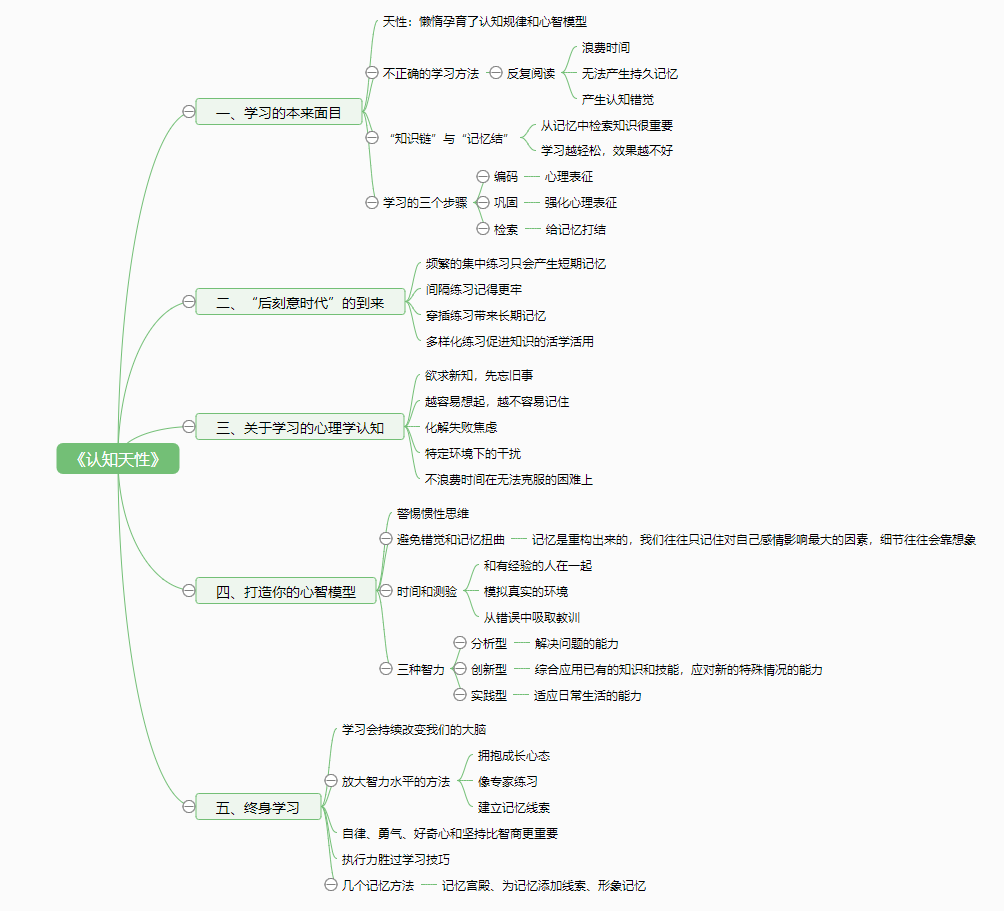
I recommend a book on learning methods called Make It Stick: The Science of Successful Learning. It describes some simple, practical learning strategies that help everyone learn better and remember longer — strategies anyone can use, anytime. These methods include various forms of retrieval practice (such as quizzes and self-testing), spaced practice, interleaving different but related subjects or skills (varied practice), trying to solve problems before being given the solution, and extracting underlying principles and rules from different types of problems. Since learning is an iterative process, you need to review previously learned material, continuously update what you know, and connect it with new knowledge.
# Retrieval-Based Learning
Practicing retrieval of new knowledge or skills from memory is an effective learning tool and a powerful weapon for maintaining long-term memory. Anything that needs to be remembered and recalled later can benefit from it — whether it's facts, complex concepts, problem-solving techniques, or motor skills.
So what exactly is retrieval-based learning? Here's my understanding: retrieving knowledge in your mind — like a quiz after class, writing down a knowledge point from memory, or even going to a job interview — all of these can be considered retrieval-based learning.
Effortful retrieval helps people achieve better learning outcomes and more lasting memories. We easily believe that the easier something is to learn, the better the results, but research shows the opposite is true. Only when the brain is forced to work does it retain what's learned more firmly. The greater the effort during retrieval — as long as you actually do it — the better it reinforces your learning. After the first test, delaying subsequent retrieval practice strengthens memory better than immediate practice, because delayed retrieval requires more effort.
Repeated retrieval not only makes memories last longer but also makes knowledge more easily retrievable in varied environments and applicable to more problems.
# Intensive Focused Practice Only Produces Short-Term Memory
People stubbornly believe that focusing on one thing and repeating it endlessly leads to better learning. But scientists distinguish between "momentary strength" during the skill-acquisition phase and "underlying habitual strength." Techniques for building habitual strength include spaced practice, interleaved practice, and varied practice — these actually slow down the apparent progress of learning. We don't see visible improvement, so we lose motivation to put in effort (most people's learning psychology works this way — they lose motivation when they can't see results). Cramming is a form of concentrated practice that has been compared to bulimia — you eat a lot, but before long, you've basically thrown it all back up.
# Spaced Practice Makes Knowledge Stick
Spacing out learning and practice over separate sessions, with intervals between them, makes learning outcomes more significant and memories more durable, effectively building habitual strength. How long should the interval be? The answer is simple: at minimum, long enough for a little bit of forgetting to occur. A little forgetting between practice sessions is a good thing, as long as it pushes people to practice harder. That said, you don't want to forget so much that retrieval becomes re-learning. Spacing practice over time consolidates memory. Sleep seems to play an important role in memory consolidation, so intervals of at least one day between practice sessions should be a good approach. Beware the trap of familiarity: you feel like you understand something and don't need to practice anymore. If you try to take shortcuts, this familiarity will hurt you during self-testing.
# Interleaved Practice Aids Long-Term Memory
Interleaving two or more topics also provides a form of spacing. Interleaving practice helps develop the ability to distinguish between different types of problems and cultivates the ability to find the right tools from an ever-growing set of solutions. With interleaved practice, you don't finish all exercises for one topic before moving to the next. You need to switch to the next topic before completing the current one's practice.
# Varied Practice Promotes Flexible Application of Knowledge
Like interleaved practice, varied practice helps learners build broader mental models. This enables them to assess changing conditions and adapt their approach accordingly. Interleaved and varied practice help learners transcend temporary memory and reach higher levels of conceptual learning, applying knowledge to real situations for more comprehensive, deeper, and more lasting learning outcomes.
# Summary
Spacing, interleaving, and variety — that's actually what life looks like. Every new project a programmer develops is a test, an exercise in retrieval practice. Every routine traffic stop for a police officer is a test, and each one is different, strengthening both explicit and implicit memory. People often say "learn from experience." Some people never seem to learn. One difference between learning and not learning may be whether people have cultivated the habit of reflection (summarizing). Reflection is a form of retrieval practice (What happened? How did I do? What could be useful?) supplemented by elaboration (What different approach should I take next time?).
# The "Snowball" Effect of Knowledge
The learning process can be divided into at least three steps: first is the encoding of information in short-term working memory. At this point, the information hasn't been consolidated into solid knowledge representation in long-term memory. Consolidation identifies and stabilizes memory traces, gives them meaning, and connects them with past experiences and other knowledge already stored in long-term memory. Retrieval updates what you've learned and enables you to apply it.
Learning always builds on what you already know. We interpret and remember events by connecting them with what we already know.
Long-term memory capacity is essentially unlimited. The more you know, the more likely you are to make connections with new knowledge.
Since long-term memory has considerable capacity, the key is having the ability to locate and recall what you know when you need it. The ease of recalling learned knowledge depends on repeated use of the information (keeping retrieval pathways from being forgotten) and on whether you've built strong retrieval cues that can reactivate your memories.
Periodic retrieval of what you've learned strengthens connections between memories, reinforces knowledge recall cues, and weakens pathways to conflicting memories. If retrieval practice isn't challenging, it won't strengthen what you've learned; the greater the difficulty, the greater the benefit.
When you recall from short-term memory — such as during rapid, frequent practice — little mental effort is required, and there are no long-term benefits. But when you recall after a period of time, when you've somewhat forgotten what you learned, you're forced to reconstruct everything. This effortful retrieval both strengthens memory and makes it malleable again, triggering reconsolidation. Reconsolidation can update your memories with new information while connecting them with recently learned material.
Repeated effortful recall or practice helps integrate learned knowledge into mental models. In a mental model, a set of related concepts or a series of motor skills are synthesized into a meaningful whole that can adapt to and function in various subsequent environments. Perception and control while driving is one example. Knowing how to hit a home run off a curveball is the same principle.
When practice conditions change or retrieval is interleaved with practice of other materials, we strengthen our ability to discriminate and generalize. Through well-rounded development, we can apply what we've learned to new environments in the future. Interleaving and variety build new connections, expand and deepen knowledge in memory, and increase the number of retrieval cues.
Trying to find the answer yourself instead of waiting for someone to give it to you, or trying to solve a problem before being given the solution, produces better learning outcomes and helps you remember correct answers or solutions longer. Even if you sometimes make mistakes, as long as there's corrective feedback, it's fine.
-- The above content is excerpted from Make It Stick, combined with my personal understanding. For more content, please refer to the book.